Poor creasing destroys packaging production budgets and ruins production timelines. Fold cracking and liner splitting ruin the visual appeal of finished goods, while high folding resistance jams automated folding-gluing lines instantly. These issues cause massive material waste and unacceptable operational downtime on the shop floor. Processing multi-ply paperboard and corrugated materials presents a strict physical challenge. You cannot simply fold thick substrates without prior tooling. Doing so guarantees immediate structural failure. Improper creasing compromises both the structural integrity and the aesthetic value of the final carton. You need exact physical conditions to achieve a perfect fold every single time. The crease must feature a deep and narrow profile with consistent depth across the entire sheet. You must achieve controlled delamination of the internal fibers without breaking the surface. Achieving these precise conditions relies entirely on your equipment. Success depends heavily on the precision, pressure control, and tooling alignment of your chosen Cardboard Die Cutting Machine.
Key Takeaways
- Material Thresholds Dictate Tooling: Any paper, cardboard, or board with a grammage exceeding 180 g/m² requires mechanical creasing to fold cleanly without fiber rupture.
- The Physics of Delamination: Optimal creasing is not about crushing the board, but delaminating the multi-ply paperboard into as many thin, undamaged layers as possible along a defined fold line to reduce folding resistance.
- Equipment Architecture Matters: Flat-bed die cutting architectures generally provide the superior pressure distribution and dwell time required for high-quality, deep, and narrow creases compared to rotary alternatives.
- Feeding Accuracy Equals Crease Accuracy: Integrating a leading edge feeder die cutter prevents board crush during intake and ensures exact registration, which is critical for aligning creases with print and cut lines.
- Quantitative Quality Control: Visual checks are insufficient; modern production requires creasing studies and stiffness testing to determine exact folding resistance before full-scale runs.
The Physics of a Clean Cardboard Fold: Defining Success Criteria
Understanding Delamination and Rib Formation
Creating a perfect fold requires specific internal mechanics. When the male rule presses into the board, it forces the material into the female matrix channel. This physical action generates intense internal shear forces within the substrate. These forces separate the internal plies of the paperboard. We call this critical process delamination. Delamination creates a pliable hinge known as the rib. A successful rib forms without breaking the outer liner fibers. Industry standards dictate specific geometry for this fold. The crease must remain deep and narrow. This geometry ensures an accurate fold during assembly and guarantees the lowest possible folding resistance on the folder-gluer line. If the crease is too shallow, the board will fight the folding process. If the crease is too wide, the fold will wander and lose its sharp edge.
The sequence of proper delamination follows a strict physical path during the machine cycle:
- The creasing rule makes initial contact with the top liner, compressing the immediate surface fibers.
- As pressure increases, the board is forced downward into the open channel of the creasing matrix.
- Shear stress builds horizontally across the internal plies, causing the adhesive bonds between the paper layers to fail.
- The internal layers separate into multiple independent, thin sheets within the localized crease zone.
- The platen reaches bottom dead center, setting the permanent memory of the newly formed rib.
- The machine opens, and the board releases from the matrix with a fully formed, undamaged hinge.
Material Variables, Grammage Thresholds, and Grain Direction
Grammage thresholds dictate your tooling requirements. Any material exceeding 180 g/m² mandates mechanical creasing. Attempting to fold heavier weights without tooling causes immediate fiber rupture. Grain direction heavily impacts overall folding resistance. Creasing in the Machine Direction (MD) aligns with the natural fiber orientation. Creasing in the Cross Direction (CD) cuts directly across these fibers. CD creases require significantly wider matrix channels. They also need deeper rule penetration to achieve proper delamination. Failing to adjust your tooling for CD creases usually results in severe liner splitting. You must map your grain direction before setting up the die. Operators must adjust their matrix selection based on this orientation.
Machine Direction vs. Cross Direction Creasing Variables
| Variable | Machine Direction (MD) | Cross Direction (CD) |
| Fiber Alignment | Parallel to crease line | Perpendicular to crease line |
| Matrix Channel Width | Standard width based on caliper | Requires wider channel (Caliper x 1.5 + Rule) |
| Rule Penetration Depth | Standard depth | Requires deeper penetration |
| Risk of Liner Splitting | Lower risk | High risk if tooling is incorrect |
| Folding Resistance | Generally lower | Significantly higher |
Visual and Structural Quality Indicators
Visual and structural quality indicators define a clean fold. You want absolutely zero fold cracking on the final product. You must see no liner splitting on the outer edges of the carton. The internal rib formation must look perfectly symmetrical. The final product should achieve a clean 90-degree fold effortlessly. It must exhibit minimal spring-back when released from the folding mechanism. A high-quality fold feels pliable and offers very little resistance. If the board snaps back aggressively, the internal delamination failed. You must inspect the corners of the fold under magnification. Look for micro-fractures in the coating or top liner. Any visible white fibers indicate a failed crease.
Conducting a Creasing Study
Quantitative testing proves essential for modern packaging runs. Visual checks alone leave too much room for operator error. You must conduct a formal creasing study before full production. Use a crease stiffness tester to measure the exact folding force required. This device clamps the sample and bends it to exactly 90 degrees. It reads the load cell to determine the resistance. The device also measures the degree of spring-back after the fold. Testing ensures the carton will run smoothly on high-speed automated folder-gluers. High folding resistance will cause the blanks to skew on the belts. This skewing leads to massive jams and wasted adhesive. A proper creasing study eliminates this risk entirely.
To execute a proper creasing study on the shop floor, follow these steps:
- Cut five sample blanks from the center and four corners of the die-cut sheet.
- Condition the samples in the testing lab to match the ambient humidity of the folder-gluer environment.
- Clamp the first sample into the crease stiffness tester, aligning the rib exactly with the bending axis.
- Engage the tester to bend the sample to 90 degrees at a standardized speed.
- Record the peak force required to achieve the 90-degree angle.
- Hold the fold for 15 seconds, release it, and measure the relaxation angle to determine spring-back severity.
How a Cardboard Die Cutting Machine Controls Creasing Conditions
Pressure, Depth, and Width Ratios
The machine dictates the exact relationship between the creasing rule and the counter matrix. You must match the rule thickness and height to the matrix channel width and depth precisely. Operators rely on micro-adjustments in machine tonnage to perfect this ratio. These adjustments accommodate slight caliper variations found in raw cardboard batches. Even minor thickness changes require immediate pressure corrections. If a new pallet of board runs slightly thicker, the crease will crack. The operator must back off the pressure by fractions of a millimeter. The machine must hold this new pressure setting consistently across thousands of impressions. Consistent pressure prevents the rule from bottoming out and crushing the internal fibers.
During the make-ready process, operators use specialized patch-up tape to manipulate pressure locally. If a specific crease on the trailing edge of the sheet lacks depth, the operator applies a 0.03mm steel tape directly under the cutting plate in that exact zone. This localized pressure increase forces the rule deeper into the matrix without over-pressurizing the rest of the die. Mastering this localized pressure control separates average operators from master die-cutters.
Tooling Variations for Complex Substrates
Tooling variations handle complex and heavy substrates effectively. Operators deploy different creasing methods based on material density and flute profile. Standard round-point rules work best for solid bleached sulfate (SBS) board. Cut-crease or perforating rules handle heavy corrugated materials better. These specialized rules achieve straight lines without warping the thicker flutes. Corrugated board tends to roll or crush under standard round rules. A cut-crease rule penetrates the top liner partially. This partial cut relieves the surface tension. It allows the heavy board to fold cleanly without crushing the adjacent flutes. Choosing the correct rule profile prevents structural damage to the packaging.
Flat-Bed vs. Rotary Equipment Dynamics
Equipment dynamics play a massive role in ultimate crease quality. Flat-bed equipment remains the industry standard for producing the best creases. A flat-bed system applies perpendicular force across the entire sheet simultaneously. It provides consistent dwell time at the bottom of the stroke. It ensures even pressure distribution from edge to edge. Rotary die cutting offers a completely different dynamic. Rotary systems use a curved impact motion against an anvil cylinder. This motion introduces potential shear stress into the board as it rolls through the nip. Rotary systems deliver much higher production speeds. However, they often force a trade-off in ultimate crease quality and depth.
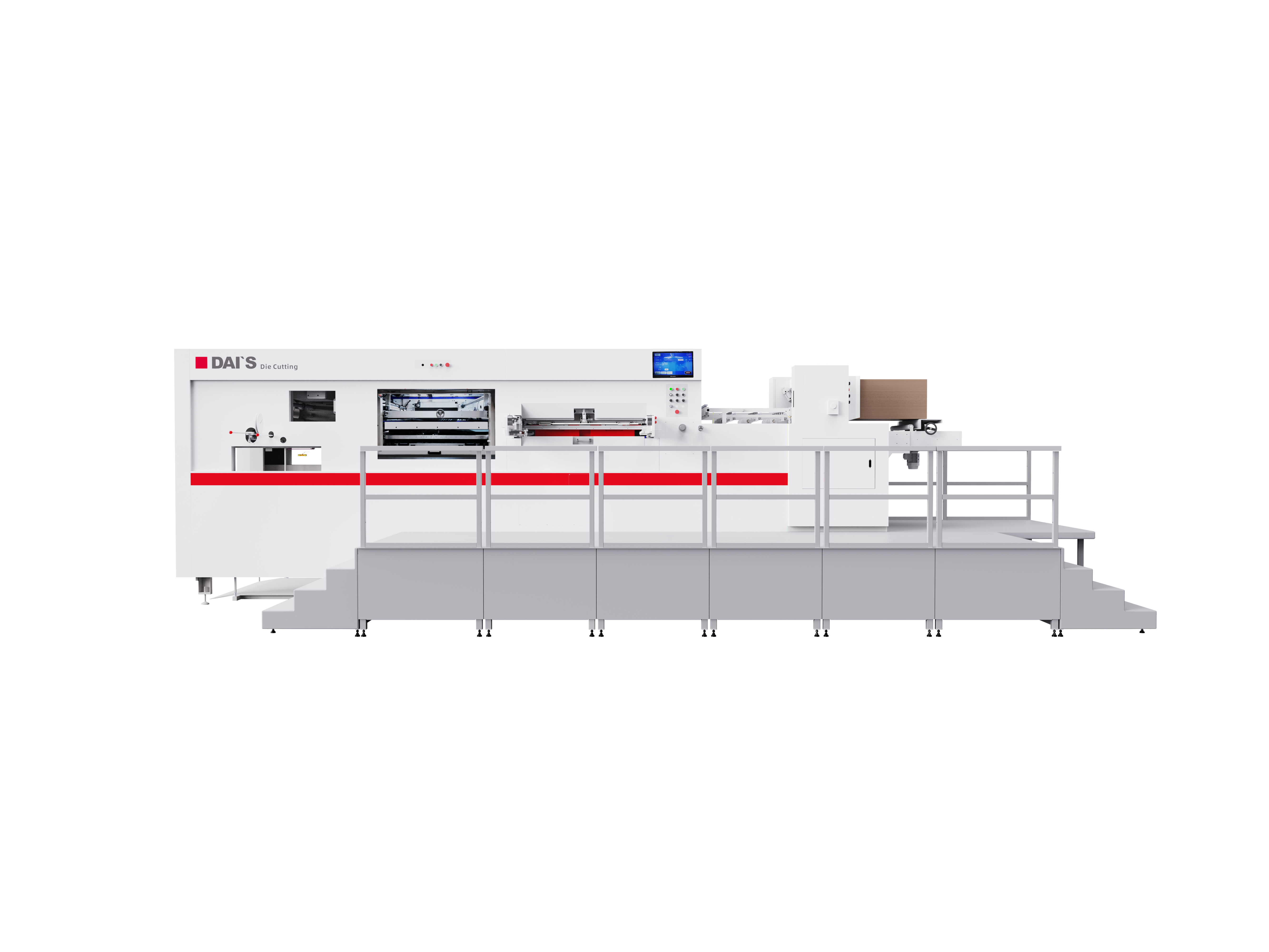
Evaluating a Paperboard Die Cutting Machine for Optimal Creasing
Tonnage Capacity and Pressure Consistency
Tonnage capacity determines your ability to crease heavy substrates effectively. You must calculate the required cutting and creasing force accurately before running a job. This calculation depends on the total linear inches of rule across the die. It factors in the overall board density and caliper. It must account for the higher CD folding resistance. A rigid platen construction prevents mechanical deflection under heavy loads. Deflection causes uneven pressure across the cutting area. You need a highly rigid platen to ensure center creases match the edges. Center creases must remain as deep and narrow as those on the perimeter. A high-quality paperboard die cutting machine maintains this uniform pressure perfectly.
When evaluating tonnage, consider the specific cutting force required for different materials. Solid board requires significantly more tonnage per linear inch than corrugated material. If your machine lacks the necessary tonnage, the platen will bow in the center. This bowing results in shallow creases in the middle of the sheet and heavy, crushed creases on the outside edges. Upgrading to a machine with a heavily ribbed, cast-iron platen eliminates this deflection entirely.
Precision Matrix and Rule Alignment (Registration)
Precision matrix and rule alignment guarantee structural accuracy. We call this critical alignment registration. You must analyze the machine's chase and cutting plate locking mechanisms. Secure locks prevent microscopic shifts during high-speed operation. If the die shifts by even half a millimeter, the crease misses the matrix channel. This misalignment destroys the rib formation instantly. Optical registration systems play a massive role in modern equipment. These cameras maintain tight tolerances sheet after sheet. They align printed graphics perfectly with the creasing matrix. They read printed fiducials on the board edge. The machine then adjusts the sheet position dynamically before the platen closes.
Dwell Time Control
Dwell time control separates average machines from exceptional ones. Dwell time refers to the microscopic pause at the bottom of the cutting stroke. Programmable dwell times allow the paperboard fibers sufficient time to deform permanently. This controlled deformation happens without snapping the brittle fibers. Short dwell times force the crease too quickly. Fast impacts shatter the coating and split the liner. Advanced machines allow operators to program this pause in milliseconds. Extending the dwell time on heavy substrates improves delamination significantly. It creates a softer, more pliable hinge. It reduces the memory effect that causes spring-back.
Material Handling: The Role of a Leading Edge Feeder Die Cutter
Preventing Pre-Crease Board Crush
Preventing pre-crease board crush starts directly at the feeder section. Traditional kick-feeders use aggressive physical force to push the sheets. They can damage the flute or internal structure of corrugated boards easily. This damage happens before the sheet even reaches the cutting section. You must preserve the board caliper at all costs to ensure accurate creasing. A leading edge feeder die cutter solves this caliper crush problem. It uses vacuum-assisted, continuous friction feeding belts. This gentle intake method protects the structural integrity of heavy boards. It pulls the sheet smoothly without crushing the leading edge. Preserving the caliper ensures the creasing rule hits the board at the exact intended depth.
Registration Accuracy at High Speeds
Registration accuracy matters immensely at high production speeds. Feeding mechanisms directly impact final crease alignment. If the sheet enters the machine skewed, the crease will fail. A skewed sheet means the crease will not align with the grain properly. It will miss the print lines entirely. This misalignment leads to asymmetrical folds on the folder-gluer. It ultimately results in rejected cartons and wasted materials. Advanced feeders use side lays and front lays to square the sheet. Vacuum belts maintain control of the sheet through the entire transfer process. This control guarantees the sheet enters the grippers perfectly straight every single time.
Selecting a Carton Die Cutting and Creasing Machine: Trade-Offs and Scalability
Production Speed vs. Crease Quality
Production speed often fights directly against crease quality. You must analyze this conceptual trade-off carefully before purchasing equipment. Running a carton die cutting and creasing machine at maximum sheets-per-hour reduces dwell time. Shorter dwell times can compromise delamination on thicker substrates. You must find the optimal balance between throughput and physical fold quality. Running at 8,000 sheets per hour might look great on a spreadsheet. However, if 10% of those sheets crack on the folder-gluer, you lose money. Operators must test maximum speeds against crease stiffness metrics. Sometimes slowing the machine down by 10% yields a 100% reduction in downstream jams.
Tooling Costs and Changeover Efficiency
Tooling costs and changeover efficiency impact your daily operations heavily. Evaluate the operational costs of steel rule dies and phenolic matrices. Setup time dictates profitability, especially for facilities handling short-run packaging. Look for specific machine features that reduce setup time drastically. Centerline systems allow rapid die positioning without manual measuring. Quick-lock frames secure tooling instantly with pneumatic clamps. Motorized pressure adjustments eliminate manual wrenching and guesswork. A machine that changes over in 15 minutes generates far more profit than one requiring an hour. Fast changeovers allow you to take on more jobs per shift.
Compliance and Safety Standards
Compliance and safety standards protect your operators from severe injury. High-tonnage flat-bed equipment carries inherent physical risks. Review all necessary safety features before operating or purchasing. Ensure the machine carries proper CE marking and safety certifications. Install and test light curtains regularly to protect the platen area. Verify all emergency stop protocols function instantly under full load. Safety mats must surround the feeder and delivery sections. Operator training must cover safe die handling and lockout-tagout procedures. Never bypass safety interlocks to speed up a make-ready process. A safe machine ensures consistent, uninterrupted production.
Implementation Risks: Troubleshooting Fold Cracking and Liner Splitting
Environmental Factors and Moisture Content
Environmental factors heavily influence folding success. Moisture content in the paperboard acts as a primary variable. Low moisture content causes severe liner splitting. This splitting happens regardless of your machine precision or tooling quality. Dry fibers become brittle and snap under heavy pressure. Ideal moisture content usually sits between 7% and 9%. You must implement strict climate control in your staging area. Utilize moisture testing protocols before running the board. Probe the pallets with a moisture meter before feeding any material. If the board is too dry, you must let it acclimate to a humidified environment. Running dry board guarantees cracked creases and rejected orders.
Matrix Wear and Maintenance Protocols
Matrix wear degrades fold quality steadily over time. The creasing matrix breaks down during long production runs. Phenolic matrices chip, and plastic matrices compress. This degradation leads to shallow, wide creases. Wide creases generate high folding resistance on the gluing line. Establish strict preventative maintenance schedules to combat this risk. Track impression counts meticulously for every single job. Standardize your matrix replacement intervals to guarantee consistent rib formation. Do not wait for the crease to fail before changing the matrix. Inspect the matrix channels for frayed edges or widened gaps. Replace worn tooling immediately to maintain pristine fold quality.
Common Creasing Defects and Mechanical Solutions
| Defect Observed | Probable Mechanical Cause | Corrective Action |
| Liner Splitting (Outside Fold) | Matrix channel too narrow or board too dry | Increase channel width; check moisture content |
| Cracking (Inside Fold) | Rule penetrating too deeply | Reduce machine tonnage or use shallower rule |
| Asymmetrical Rib | Die registration shifted | Re-align chase and verify locking mechanisms |
| High Folding Resistance | Insufficient dwell time or shallow crease | Increase dwell time; verify platen pressure |
| Flute Crush (Corrugated) | Standard round rule used on heavy flute | Switch to cut-crease or perforating rule |
Conclusion
Take these actionable steps to ensure optimal creasing conditions:
- Schedule a manufacturer demo using your facility's specific >180 g/m² substrates to test real-world capabilities.
- Conduct a formal creasing study during the demo to verify delamination and measure folding resistance using a stiffness tester.
- Audit your current tooling inventory to ensure you have the correct matrix channel widths for both MD and CD grain directions.
- Implement strict moisture testing protocols for all incoming paperboard pallets before they reach the feeder section.
FAQ
Q: What is the difference between folding and creasing cardboard?
A: Folding is bending the material without tools, which causes cracking in heavy materials. Creasing uses mechanical tools to pre-weaken and delaminate the board, creating a pliable hinge for a clean fold.
Q: At what paper weight (grammage) is creasing absolutely necessary?
A: Any paperboard or cardboard exceeding 180 g/m² requires mechanical creasing. Attempting to fold materials above this weight without tooling will cause fiber rupture and liner splitting.
Q: Why does my cardboard crack when folded even after die cutting?
A: Cracking usually results from insufficient moisture content in the board, an incorrect creasing rule-to-matrix ratio, creasing against the grain without proper tooling adjustments, or inadequate machine pressure preventing proper delamination.
Q: How do you measure creasing quality?
A: You measure quality through a formal creasing study. This involves visual inspection for rib formation and liner splitting, combined with quantitative testing using a crease stiffness tester to measure folding resistance and spring-back.
Q: How does a leading edge feeder improve die cutting quality?
A: It uses vacuum belts to pull the sheet gently, preventing the crushing of the board's caliper during feeding. It also ensures precise sheet registration, leading to highly accurate crease placement.
Q: Are flat-bed or rotary die cutters better for creasing?
A: Flat-bed die cutters are generally better for creasing. They provide perpendicular force, even pressure distribution, and consistent dwell time, which are essential for creating deep, narrow creases without shear stress.


