Introduction
When shopping for an Electric paper cutter, the technical specification sheet can feel like a foreign language. Two terms dominate these documents: Sheet Capacity and Cut Length. While they seem straightforward, they are the "engine specs" of your machine. Misunderstanding them leads to jagged edges, burnt-out motors, or equipment that simply cannot fit your project.
An Automatic cutting solution is a significant investment for any print shop or office. You aren't just buying a blade; you are buying a workflow. This guide breaks down what these numbers actually mean in the real world.
Decoding Sheet Capacity: More Than Just a Number
Sheet capacity refers to how many pages an Electric paper cutter can slice through in a single downward motion. Most manufacturers base this on standard 80gsm (20lb) bond paper. However, if you are working in a professional print environment, you rarely use only standard office paper.
The Weight Factor
If a machine claims a 500-sheet capacity, it means it can handle a stack roughly 50mm thick of standard paper. If you switch to Heavy duty cardstock or gloss-coated brochure paper, that capacity drops significantly. The density of the fibers and the slickness of the coating change how much force the motor needs to apply. A High-quality Electric paper cutter will often list capacity in "stack height" (inches or millimeters) rather than just "sheets" to provide a more accurate measurement.
Mechanical Stress and Motor Longevity
Constantly pushing an Automatic cutter to its maximum sheet capacity is like redlining a car engine. It creates heat. Over time, this dulls the blade faster and strains the drive assembly. To ensure your Electric paper cutter remains a Durable asset, we recommend operating at 80% of its rated capacity for daily tasks. This "buffer" preserves the High precision of the cut and prevents the clamp from leaving indentations on the top sheets of your stack.
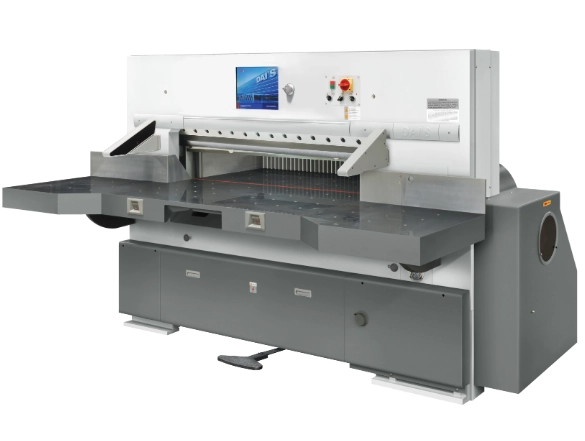
Mastering Cut Length: Why Size Matters for Versatility
Cut length is the horizontal distance the blade covers. It determines the maximum width of the paper you can slide into the machine. While a small office might only need to trim A4 paper, a professional shop often requires a Large format Electric paper cutter to handle SRA3 or even larger architectural plots.
Beyond the Standard Dimensions
If you buy a cutter with a 12-inch cut length, you are locked into that size. You cannot "double-cut" a 24-inch sheet with any degree of accuracy. Therefore, an Electric paper cutter with a generous cut length offers better future-proofing. It allows you to buy bulk paper sizes—which are cheaper—and trim them down to Custom sizes in-house.
Clearance and Maneuverability
An important "Expert Insight" is the difference between cut length and table depth. You need enough room behind the blade to push the paper through. A Digital control system is useless if the backgauge cannot move far enough back to accommodate your Large format sheets. Always look for a machine where the cut length is slightly wider than your largest intended project to allow for easy rotation and bleed trimming.
The Synergy of Digital Control and High Precision
Modern finishing requires more than raw power; it requires intelligence. This is where Digital control and a with LCD display interface transform a simple tool into a High precision instrument.
How Digital Control Solves Precision Challenges
Eliminating Manual Error
Old-fashioned manual backgauges require the operator to squint at a physical ruler. An Electric paper cutter with LCD display allows you to input measurements down to 0.1mm. The backgauge moves automatically to the exact position. This is vital for "step-and-repeat" jobs where you are cutting multiple business cards from a single large sheet.
Memory Functions for Complex Jobs
We often see shops that repeat the same cut patterns every week. Digital control allows you to save these sequences. With the touch of a button, the Automatic backgauge adjusts for the first cut, then the second, and so on. This consistency ensures that every stack is identical, which is the hallmark of a professional High precision finish. It also reduces waste, as there is no "trial and error" involved in setting up the machine.
Heavy Duty Construction vs. Light-Use Models
Not all machines are built for the same "duty cycle." A Heavy duty Electric paper cutter is engineered for multi-shift operations, while lighter models are for occasional trimming.
Frame Rigidity and Vibration
When a blade slices through 400 sheets, it exerts tons of pressure. A light frame will flex, causing the bottom sheets of the stack to be a different size than the top sheets. A Heavy duty machine uses a cast-iron or thick steel frame to absorb this energy. This rigidity is what maintains High precision across the entire stack. If the machine shakes during the cut, your edges will be jagged.
Blade Material and Replacement
The blade in a High-quality Electric paper cutter is usually made of High-Speed Steel (HSS) or Tungsten Carbide. These materials stay sharp longer even when facing Large format jobs.
HSS Blades: Great for general purpose, easy to resharpen.
Carbide Blades: Stay sharp up to 10x longer but are more brittle and expensive. Procurement officers should consider the long-term cost of blade sharpening when choosing between a standard or Heavy duty model.
Safety Specifications: Protecting the Operator
High-capacity cutting involves a very sharp blade and significant mechanical force. The specs for safety features are just as important as the cutting specs.
Infrared Safety Curtains
A modern Automatic Electric paper cutter should include infrared sensors. If a hand or object breaks the light beam, the blade stops instantly. This is a non-negotiable feature for any professional environment. It allows for a faster workflow than physical plastic shields while providing superior protection.
Two-Hand Operation
To prevent accidental activation, manufacturers require the operator to press two separate buttons simultaneously to start the cut cycle. This ensures both hands are clear of the cutting zone. When combined with an Automatic clamp, this system provides a safe, efficient environment for handling Heavy duty stacks.
| Safety Feature | Function | Importance |
| Infrared Sensors | Stops blade if light beam is broken | Essential |
| Two-Hand Control | Keeps hands away from the blade | High |
| Emergency Stop | Immediate power cutoff | Critical |
| Blade Lock | Prevents blade from "drifting" down | High |
Understanding the "Bleed" and "Trim" Specs
In the printing world, we don't just cut to the final size; we cut to the "bleed." Understanding how your Electric paper cutter handles these small margins is the key to a perfect product.
The Role of the Optical Cutting Line
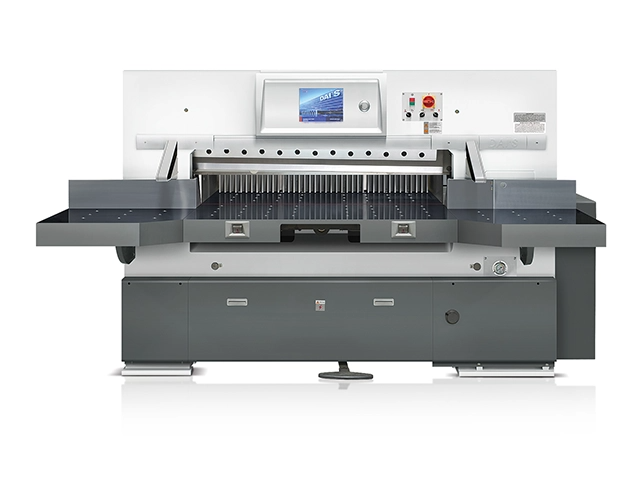
Many High precision cutters project a red laser line onto the paper. This shows exactly where the blade will strike. This is invaluable when you are trimming Large format posters where the image goes right to the edge. It allows the operator to align the stack visually before engaging the Automatic clamp.
Backgauge Accuracy and Squaring
If your backgauge is not perfectly square to the blade, your "rectangle" will be a "trapezoid." Higher-end Electric paper cutter models feature adjustable backgauges. This allows a technician to fine-tune the machine to within microns. For jobs involving Digital control, this mechanical alignment is what allows the software to deliver on its promise of High precision.
Maintenance Specs: Keeping Your Cutter at Peak Performance
Your machine's lifespan is dictated by how well it is maintained. The specs for lubrication and blade changes should be part of your buying criteria.
Self-Diagnostic Systems
Advanced Electric paper cutter models with LCD display can actually tell you when they need service. They track the number of cuts and alert you when it is time to lubricate the lead screw or change the blade. This proactive approach prevents the "Automatic" components from wearing out prematurely due to friction.
Blade Changing Tools
Changing a Heavy duty blade is a dangerous task if not done correctly. Look for machines that include a blade-change cradle or specialized tools. An expert-level Electric paper cutter is designed so that a single person can safely swap the blade without exposing the sharp edge. This reduces downtime and keeps your Large format production moving.
Conclusion
Understanding Sheet Capacity and Cut Length is the foundation of a successful finishing department. By looking past the basic numbers and considering factors like motor duty cycles, Digital control precision, and frame rigidity, you can select an Electric paper cutter that truly fits your needs. Whether you require a Heavy duty workhorse or a High precision tool for delicate Custom work, these specs are the roadmap to a reliable, high-quality output.
FAQ
Q1: Can I cut materials other than paper with an Electric paper cutter?While they are designed for paper, Heavy duty models can handle thin plastics, business card magnets, and light cardstock. However, cutting very hard materials can chip the blade and void the warranty of your Automatic machine.
Q2: How often should I sharpen the blade?It depends on usage. For a busy shop doing Large format runs daily, we recommend sharpening every 2 to 4 weeks. If you notice "dust" on the edges of the paper or a loud "thumping" sound during the cut, the blade is dull.
Q3: Is an Automatic clamp better than a manual one?Yes. An Automatic clamp ensures consistent pressure across the entire stack. Manual clamps often lead to "paper shift," where the top sheets are cut differently than the bottom ones, ruining your High precision results.
Our Factory and Manufacturing Strength
At our core, we are more than just a supplier; we are a dedicated manufacturer with a sprawling, state-of-the-art factory focused on the evolution of paper finishing technology. We specialize in producing Electric paper cutter solutions that bridge the gap between industrial power and Digital control ease. Our facility is equipped with advanced CNC machining centers to ensure that every frame and backgauge we produce meets the highest standards of High precision.
We take immense pride in our R&D capabilities. By listening to the needs of B2B clients, we have developed a range of Heavy duty and Large format cutters that feature intuitive with LCD display interfaces. Our strength lies in our rigorous quality control; every Automatic unit is tested through thousands of cycles before it leaves our floor. We understand that our customers need more than a machine—they need a reliable partner. That is why we focus on durability, safety, and the "Expert Insight" required to keep your production line moving without interruption.


