Introduction
In the high-stakes world of commercial printing, time is the most expensive commodity. A beautiful print job means nothing if the final trim is jagged or delayed. This is where the Heavy duty Electric paper cutter transforms from a simple tool into a central hub of productivity. Unlike manual trimmers that rely on physical strength and guesswork, modern electric systems provide the muscle and brains required to handle thousands of sheets per hour.
Maximizing efficiency in a print shop requires more than just speed; it demands High precision and repeatable accuracy. When a shop integrates an Automatic cutting solution, they eliminate the "bottleneck" at the finishing station. This guide explores how top-tier print shops leverage advanced features—like Digital control and infrared safety sensors—to streamline their workflow, reduce waste, and keep their margins healthy.
Eliminating Manual Bottlenecks with Automatic Power
The most immediate efficiency gain comes from the transition from physical labor to automated force. In a busy shop, a technician shouldn't spend their energy pulling a lever. A Heavy duty Electric paper cutter uses powerful motors to drive the blade through thick stacks of cardstock, coated paper, or even plastic substrates with zero effort.
Consistent Pressure and Speed
Manual cutting often results in "paper draw," where the top sheets move differently than the bottom sheets because of uneven pressure. An Automatic clamping system solves this. It applies thousands of pounds of even pressure before the blade ever moves. This ensures every sheet in a 500-page stack is exactly the same size. For a commercial shop, this means fewer reprints and faster job turnover.
Reducing Operator Fatigue
Fatigue leads to mistakes. By using an Electric paper cutter, operators stay fresh throughout an eight-hour shift. They can focus on quality control and organization rather than the physical strain of the cut. When the machine does the heavy lifting, the shop can maintain a steady "beats per minute" in production, making it easier to predict delivery times for clients.
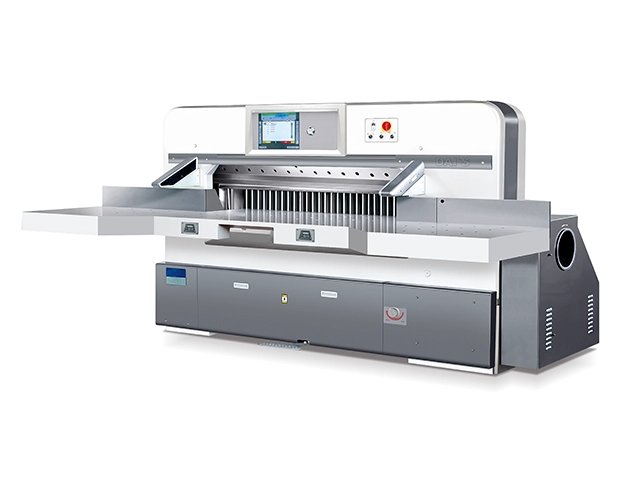
Achieving High Precision Through Digital Control Systems
Precision is the hallmark of a professional print shop. If a business card is off by even a millimeter, the branding looks amateur. Modern shops use an Electric paper cutter equipped with Digital control to ensure every dimension is mathematically perfect.
The Power of Programmed Cutting Sequences
Automating Complex Layouts
Most high-end machines allow users to save "programs." For example, if you frequently trim 12x18 sheets down to standard A4, you can save that sequence. The Digital control backgauge moves automatically to the next position after every cut. This eliminates the need for the operator to manually measure or turn a handwheel between trims.
Enhancing Accuracy with Micro-Adjustments
With an Electric paper cutter with LCD display, technicians see exactly where the backgauge is positioned down to 0.01mm. This level of High precision is vital for "full bleed" prints where the design goes to the very edge. The screen provides instant feedback, allowing the operator to make micro-adjustments if the paper has expanded or contracted due to humidity—a common issue in print environments.
Reducing Calculation Errors
In the past, an operator had to do the math for "gutters" and "margins" in their head. Now, the Digital control system handles the division. You simply input the original sheet size and the desired final size, and the Automatic backgauge does the rest. This prevents "math fatigue" and the costly errors that come with it.
Large Format Capabilities for Diverse Revenue Streams
Commercial shops often lose money because they have to outsource jobs that are too large for their equipment. Investing in a Large format Electric paper cutter allows a shop to keep those profits in-house.
Handling Bulk and Oversized Stock
A Large format machine typically features a wider cutting table and a higher "opening" (the vertical space under the blade). This allows the shop to buy paper in bulk "parent sheets," which are significantly cheaper than pre-cut sizes. By cutting their own stock down, they save on material costs and can offer Custom sizes that competitors cannot.
Versatility Across Substrates
It isn't just about paper. A Heavy duty Electric paper cutter can handle laminated materials, thin vinyl, and heavy greyboard used in bookbinding. This versatility allows a shop to expand into packaging, signage, and specialty stationery. The more materials a single machine can handle, the higher the Return on Investment (ROI) for the shop owner.
| Feature | Standard Cutter | Large Format Electric paper cutter |
| Max Width | 12 - 18 inches | 20 - 30+ inches |
| Stack Height | 1 inch | 3 - 4 inches |
| Drive Type | Manual/Semiauto | Fully Automatic / Hydraulic |
| Ideal For | Copy Shops | Commercial Print / Packaging |
Safety as an Efficiency Driver: Infrared and Two-Handed Operation
It might seem counterintuitive, but safety features actually speed up production. When an operator feels safe, they work faster and with more confidence. An Electric paper cutter is a dangerous piece of machinery if not properly equipped.
Infrared Safety Curtains
Modern Heavy duty cutters utilize infrared light beams across the cutting table. If a hand or even a stray piece of paper breaks that beam, the blade stops instantly. This prevents accidents that could shut down a shop for weeks. More importantly, it allows the operator to move quickly around the machine without the fear of mechanical failure or accidental triggering.
Two-Handed Safety Activation
To trigger the cut, most Automatic systems require the operator to press two buttons simultaneously, located far apart. This ensures both hands are out of the "danger zone." Because this becomes a rhythmic motion, operators develop a fast, safe cadence. It creates a predictable workflow that minimizes "near-miss" incidents and keeps the production line moving without interruption.
Improving Workflow with LCD Displays and Real-Time Diagnostics
Information is the key to maintaining efficiency. An Electric paper cutter with LCD display serves as the communication bridge between the technician and the hardware.
Real-Time Monitoring and Troubleshooting
Visualizing the Cut Path
The LCD display doesn't just show numbers; it often shows the "cut line." Some machines use an optical LED line that shines onto the paper, showing exactly where the blade will fall. This allows the operator to verify the alignment visually before committing to the cut, which is a massive time-saver for Custom one-off jobs.
Error Coding and Maintenance Alerts
When a machine goes down, every minute costs money. A Digital control system with an LCD display provides specific error codes. Instead of guessing why the backgauge isn't moving, the screen might tell the operator that a safety sensor is blocked or a fuse needs replacing. This allows for "self-service" on minor issues and gets the Heavy duty machine back into production faster.
Simplified Training for New Staff
The print industry often faces high turnover or seasonal spikes in labor needs. An intuitive Electric paper cutter with a clear interface makes training much faster. A new employee can learn to run a pre-programmed sequence in minutes rather than hours, ensuring that the finishing department never falls behind, even during the holiday rush.
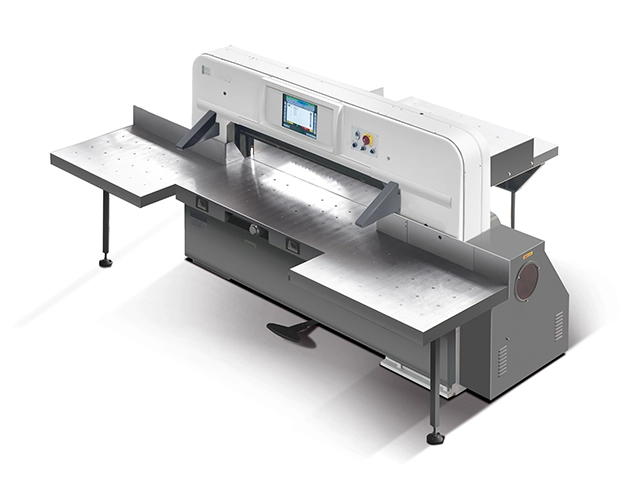
The Role of Hydraulic vs. Electric Drive in Heavy Duty Cutting
While we use the term Electric paper cutter generally, commercial shops must choose between purely electric motors and hydraulic-assisted systems. Both have their place in an efficient workflow.
Electric Screw-Drive for Speed
Purely electric cutters often use a "ball-screw" drive for the backgauge. This is incredibly fast and quiet. It is perfect for shops that do many small-to-medium trims, such as flyers or postcards. It provides the High precision needed for digital print work where the registration is very tight.
Hydraulic Force for Maximum Density
For a shop that specializes in thick books or heavy cardstock, a hydraulic Heavy duty system is often preferred. Hydraulics provide a more "consistent" pressure for the clamp and blade, which is necessary when cutting through 500+ sheets of 100lb cover stock. It prevents the blade from "stalling" or slowing down mid-cut, maintaining a consistent cycle time regardless of the material thickness.
Reducing Waste Through Intelligent Scrap Management
Efficiency isn't just about how fast you cut; it's about how much paper you throw away. An Electric paper cutter helps minimize waste through better planning and "nesting" capabilities.
Maximizing Sheet Yield
By using Digital control, shops can calculate exactly how many pieces fit on a parent sheet. The machine's accuracy allows for "zero-margin" cutting in some cases, where the blade falls exactly on the shared line between two pieces. This reduces the amount of "trim scrap" produced. Over a year of high-volume production, saving even 5% of your paper through better cutting can add thousands of dollars to the bottom line.
Protecting the Bottom Sheet
High-quality Heavy duty cutters use a "cutting stick"—a plastic strip the blade sinks into after passing through the paper. An Automatic machine ensures the blade depth is perfectly calibrated so it doesn't dull the blade too quickly or mar the bottom sheet of the stack. This ensures 100% yield from every stack, from the top page to the very last one.
Longevity and ROI of Professional Finishing Equipment
A Heavy duty Electric paper cutter is a significant investment, but it is one of the most "durable" assets in a print shop. Unlike digital presses that may become obsolete in five years, a well-maintained cutter can last decades.
Low Maintenance Requirements
Modern electric cutters are designed with fewer "wear parts" than old mechanical versions. The Digital control systems are solid-state, and the motors are often brushless, requiring very little upkeep. Regular blade sharpening and occasional lubrication of the backgauge are usually all that is needed to keep the machine running at High precision for years.
Resale Value and Business Growth
Because these machines are so Durable, they hold their value incredibly well. As a shop grows, they can often trade in their mid-sized Electric paper cutter for a Large format model. This ability to scale equipment alongside business growth is a key strategy for the most successful commercial printers.
Conclusion
The transition to a Heavy duty Electric paper cutter represents a turning point for any print shop. It moves the business away from the limitations of manual labor and into the realm of Automatic speed and High precision. By utilizing Digital control and clear LCD displays, shops can eliminate errors, protect their workers, and handle a wider variety of Large format jobs. In the end, efficiency is found in the small details—the saved minute on a program, the saved sheet in a stack, and the confidence of a perfect cut every single time.
FAQ
Q: Can an Electric paper cutter handle materials other than paper?
A: Yes. A Heavy duty model can cut through laminates, thin plastics, leather, and cardboard. However, you must ensure the blade is sharpened correctly for the specific material to maintain High precision.
Q: How often does the blade need to be changed?
A: In a commercial environment, blades are typically changed or rotated every 20 to 40 hours of actual cutting time. Using an Automatic machine helps extend blade life by ensuring the cut is always made with optimal force.
Q: Is an Electric paper cutter better than a hydraulic one?
A: It depends on your volume. A standard Electric paper cutter is great for speed and High precision on smaller stacks. Hydraulic systems are better for "extreme" Heavy duty work where you are cutting very thick, dense stacks all day long.
Our Factory and Manufacturing Strength
At our company, we don't just sell machines; we manufacture solutions. We operate a state-of-the-art production facility where we design and build the very Heavy duty Electric paper cutter technology mentioned in this guide. Our factory is equipped with high-precision testing rigs to ensure that every Digital control system is calibrated to perfection before it leaves our floor.
We take immense pride in our engineering strength. Our team focuses on integrating the latest Automatic safety features and LCD display interfaces to make our machines the most user-friendly in the market. We understand the B2B landscape—we know that when your machine is down, your business stops. That is why we build our cutters to be the most Durable and reliable assets in your shop. From the heavy iron castings to the refined electronic sensors, we control every step of the manufacturing process to ensure our clients receive world-class finishing equipment.


