Choosing the right Paper cuting machine is one of the most important decisions in post-press finishing. A well-matched cutter improves daily efficiency, keeps cut sizes consistent across repeat jobs, and helps your team maintain a smooth workflow from printed sheets to finished stacks.
This guide compares electric and hydraulic paper cutters in a practical, business-focused way. You’ll learn how each type of Paper cuting machine supports different production goals, what specifications matter most, and how to select the best configuration for your materials, volume, and accuracy needs.
1. Why the Right Paper cuting machine Matters
A Paper cuting machine is often the “gatekeeper” of finishing. Before laminating, die cutting, hot foil stamping, folding, binding, or packing, many jobs depend on accurate trimming. When cutting is stable and repeatable, everything downstream becomes easier to control.
Key business benefits of selecting the right Paper cuting machine include:
Consistent finished size for packaging, book blocks, labels, and inserts
Higher throughput through faster setup and predictable cutting cycles
Cleaner workflow planning for daily job scheduling and repeat orders
Safer operation through modern guarding, two-hand controls, and reliable clamping routines
Better utilization of operators and floor space with the right cutting width and automation level
2. Quick Definition: Electric vs. Hydraulic Paper cuting machine
Both electric and hydraulic cutters aim for the same outcome—accurate stacks cut to precise sizes. The difference lies in how key actions such as clamping and cutting are powered and controlled.
2.1 Electric Paper cuting machine
An electric Paper cuting machine uses electric motors and drive systems to perform functions such as backgauge movement, clamping, and cutting (depending on the model). In modern designs, electric cutters often pair with digital controls for measurement, programming, and repeatability.
Typical fit: operations that value structured job setup, repeat cutting programs, and efficient changeovers across varied daily orders.
2.2 Hydraulic Paper cuting machine
A hydraulic Paper cuting machine uses hydraulic power for stable pressure and strong, controlled movement—commonly applied to clamping and cutting actions. Hydraulic systems are widely used in industrial settings where consistent force and smooth stack handling are priorities.
Typical fit: production environments prioritizing steady output, strong stack management, and robust finishing workflows.
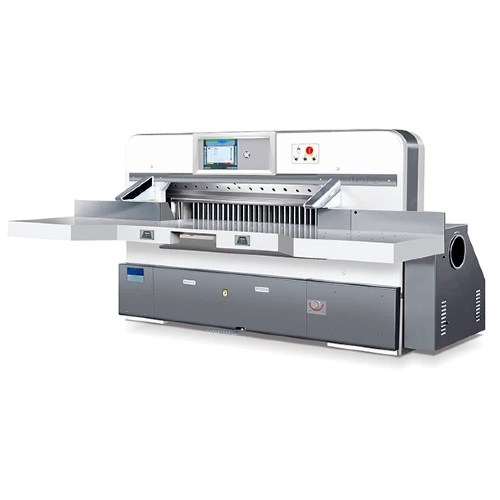
3. Core Components of Any Paper cuting machine (What Drives Cut Quality)
Before comparing types, it helps to understand the components that determine performance in any Paper cuting machine:
Knife/Blade: the cutting edge that must stay sharp and properly aligned
Clamp: holds the stack firmly to prevent shifting during the cut
Backgauge: positions paper to exact measurements; accuracy here determines repeatability
Cutting Table & Side Lays: supports the stack and guides alignment
Control System: provides measurement input, job programming, and cutting sequences
Safety System: guards, two-hand operation, emergency stops, and safe access zones
When these parts work together smoothly, a Paper cuting machine delivers consistent sizing, clean edges, and reliable repeat results.
4. Electric vs. Hydraulic Paper cuting machine: What to Compare
A smart selection comes from matching machine capabilities to your real production priorities. Use the framework below to compare options without guessing.
4.1 Cutting force and material range
Your product mix may include standard paper, coated sheets, thicker cardstock, or laminated sheets. A well-specified Paper cuting machine should align with your typical stack height and material stiffness.
What to evaluate:
target stack height and stack stability during clamping
materials used most frequently (paper weight ranges, coated stocks, laminated sheets)
desired cutting rhythm across a workday
4.2 Precision and repeatability
Repeat jobs demand predictable measurements. For many teams, the backgauge system and control features matter as much as cutting action.
What to evaluate:
backgauge accuracy and movement stability
digital measurement system and calibration routines
ability to save and recall programs for repeat cuts
4.3 Productivity and workflow efficiency
Output depends on how quickly operators can set up a job, run multi-step cutting, and change between orders.
What to evaluate:
program storage and job recall
step-cut sequences for complex trimming patterns
user-friendly controls that reduce setup friction
4.4 Control system and usability
Today’s Paper cuting machine selection is also a software decision. Controls influence speed, error reduction, and training time.
What to evaluate:
clear interface for measurements and job steps
program editing and naming
unit conversion (mm/inch), step cuts, repeat cuts, memory functions
4.5 Safety and compliance essentials
A Paper cuting machine must support a safe cutting station that operators can run with confidence.
What to evaluate:
proper guarding and protected cutting area
two-hand operation logic where required
emergency stop placement and accessibility
5. Comparison Table: Electric vs. Hydraulic Paper cuting machine
Use this table as a quick reference. The goal is to align strengths with your business needs and workflow targets.
Selection Factor | Electric Paper cuting machine | Hydraulic Paper cuting machine | What This Means for Your Business |
Best-fit workflow | Structured job changes, repeat programs, flexible daily orders | Production-oriented cutting stations, stable stack handling | Choose based on how often you change jobs and how you batch work |
Stack handling focus | Efficient positioning and programmed sequences | Stable pressure control and consistent stack clamping | Match to stack height targets and material stiffness |
Precision support | Strong digital control options and repeat-job programming | Stable operation with strong clamping performance | Both can be precise—prioritize backgauge accuracy and control features |
Productivity levers | Fast setup with programs, step cuts, job recall | Consistent cutting rhythm and stable clamping cycles | Pick the type that matches your daily output style |
Control system emphasis | Interface and programming features are key differentiators | Controls + hydraulic stability for industrial routines | Confirm the specific control functions you’ll use most |
6. How to Choose the Right Paper cuting machine (Step-by-Step)
Step 1: Confirm your sheet size and cutting width requirements
Cutting width is often the first filter. You want a Paper cuting machine that comfortably handles your most common sheet sizes and layouts.
Checklist:
main sheet sizes (e.g., common parent sheets)
maximum width you expect to cut
alignment needs for trim marks and finished sizes
Step 2: Define your daily cutting volume and peak demand
Production volume is not just “how much you print,” but how much you cut and how often you cut.
Checklist:
average number of cutting jobs per day
peak days and rush schedules
whether you typically run long batches or many short orders
Step 3: List your materials and finishing process chain
A Paper cuting machine supports the entire finishing chain. Consider what happens before and after cutting.
Checklist:
typical paper weights and coatings
whether sheets are laminated before trimming
whether cut stacks go to die cutting, folding, binding, or packing
Step 4: Decide the automation level that fits your team
Automation is not about complexity—it’s about reducing repetitive setup and making results consistent.
Checklist:
program memory for repeat jobs
step-cut sequences for multi-stage trimming
measurement workflow that reduces manual calculation
Step 5: Plan for layout and integration
A Paper cuting machine works best when the cutting station is designed for smooth feeding, stacking, and material flow.
Checklist:
operator working space and safe access zones
upstream staging (paper pallets, lifts, or feeding tables)
downstream stacking, packing, or next-process transfer
7. Buyer Checklist: What to Confirm Before Purchasing a Paper cuting machine
Use this list to guide your supplier conversations and internal evaluation.
7.1 Core specifications
Cutting width (fits your common sheets)
Maximum cutting height/stack height (fits your volume style)
Backgauge travel range (supports trim patterns and positioning)
Backgauge accuracy (supports repeat work and tight tolerances)
7.2 Control and workflow features
program storage capacity
step-cut sequencing
job recall and editing
measurement unit options and clear display logic
7.3 Operational readiness
blade management approach (maintenance workflow, safe handling)
manuals, training, and documentation quality
spare parts planning and support process
A well-specified Paper cuting machine is more than a cutter—it becomes a predictable system your finishing team can rely on every day.
8. Conclusion
If your production relies on accurate trimming, consistent sizing, and smooth post-press flow, choosing the right Paper cuting machine should be a structured decision—not a guess.
To select with confidence, we recommend aligning the cutter type with your volume rhythm (frequent job changes vs. steady production cutting), prioritizing cutting width, stack height, and backgauge accuracy, choosing control functions that improve repeatability and setup speed, and ensuring your cutting station supports safe, stable daily operation.
When you’re ready to evaluate a solution, we can help you narrow down the best configuration. Please prepare your most common sheet sizes, target cutting width, typical stack height, daily cutting volume pattern, and primary materials (paper weights, coated stocks, laminated sheets). Share these details with DAI’S Printing Machinery Co., Ltd., and we will recommend a suitable Paper cuting machine setup and provide a quotation with technical guidance. Contact us to discuss your workflow and get tailored specifications for your business.
FAQ
1) What is the main difference between an electric and hydraulic Paper cuting machine?
An electric Paper cuting machine relies on electric drive systems for core functions and often emphasizes digital control and programmed workflows. A hydraulic Paper cuting machine uses hydraulic power to provide stable pressure and strong, consistent stack handling—commonly used in production-oriented cutting stations.
2) Which Paper cuting machine is better for higher production output?
A higher-output setup typically benefits from a Paper cuting machine configuration that supports stable stack handling, consistent cutting cycles, and efficient job batching. Compare machine types based on your daily cutting rhythm, stack height targets, and program features.
3) How do I choose the right cutting width for my Paper cuting machine?
Start from your most common sheet sizes and add margin for comfortable alignment and workflow. The right Paper cuting machine cutting width should handle your primary sheets without forcing rotation or awkward positioning.
4) What features improve accuracy and repeatability on a Paper cuting machine?
Key contributors include a precise backgauge system, stable clamping, clear digital measurement input, and program storage for repeat jobs. A Paper cuting machine with step-cut sequences also helps maintain consistent multi-stage trimming.
5) Can a Paper cuting machine handle coated, thicker, or laminated sheets?
Yes—when the Paper cuting machine is properly specified for your material stiffness and stack height needs, and when clamping stability and blade condition are managed correctly.
6) What information should I prepare before requesting a quotation for a Paper cuting machine?
Provide sheet size range, desired cutting width, typical stack height, daily cutting volume style, and your main materials (paper weights, coated stocks, laminated sheets). This enables a supplier to recommend the best-fit Paper cuting machine configuration.
7) What safety features should a modern Paper cuting machine include?
A modern Paper cuting machine should support a protected cutting area, reliable safety controls (such as guarded access and emergency stops), and a clear operator workflow that encourages safe daily operation.


